Lighting & Ambience
Kelvin Temperature: Choosing Bedroom Light
What 2700K, 3000K, 3500K and 4000K actually look like in a bedroom, where each belongs, and how to read a bulb box without guessing.
By Mara Bennett · Published March 27, 2026 · Updated March 27, 2026

Kelvin is the number on the bulb box that decides whether a room feels warm or clinical, and it is the one most people skip. Brightness gets the attention, but I have walked into more bedrooms ruined by the wrong color temperature than by the wrong brightness - the 4000K bulbs that turn linen and oak into a dentists’ waiting room, the mismatched pair of lamps where one glows amber and one glows blue. The fix takes one shopping decision, made once. This guide gives you the four temperatures worth knowing, where each belongs in a bedroom, and how to buy them without guessing.
What kelvin actually measures
Color temperature describes the tint of white light, measured on the kelvin scale. The counterintuitive part: lower numbers mean warmer light. A low-kelvin bulb glows amber and candlelike; a high-kelvin bulb glows whiter and bluer. The Department of Energy’s lighting guidance puts it plainly - around 2700K is the warm light most incandescent bulbs produce, and it is the range that complements wood finishes, furniture, and fabric.
ENERGY STAR certifies bulbs at six designated temperatures: 2700K, 3000K, 3500K, 4100K, 5000K, and 6500K. For a bedroom you will live at the warm end of that list, and the four temperature points below cover every decision in the room.
The four temperatures worth knowing
| Kelvin | Trade name | How it reads | Where it belongs |
|---|---|---|---|
| 2700K | Warm white, soft white | Amber, close to candlelight | Bedside lamps, ambient lamps, accent light |
| 3000K | Soft white, warm white | Warm but a touch cleaner | Dressing areas, closet interiors |
| 3500K | Neutral white | Neither warm nor cool | Rarely useful in a bedroom |
| 4000K+ | Cool white | Crisp, blue-leaning, clinical | Not for sleeping rooms |
The Department of Energy’s purchasing guide pairs these ranges with moods: 2700K reads friendly and personal, 3000K warm and pleasing, 3500K neutral, and 4100K neat and efficient - a description that sounds useful until you realize it is describing an office. Bedrooms are not offices. The table is worth keeping as a map of what to avoid as much as what to choose.
Where each temperature belongs in the bedroom
The working rule is one temperature for the sleeping end of the room, and permission for slightly cooler light only where you get dressed.
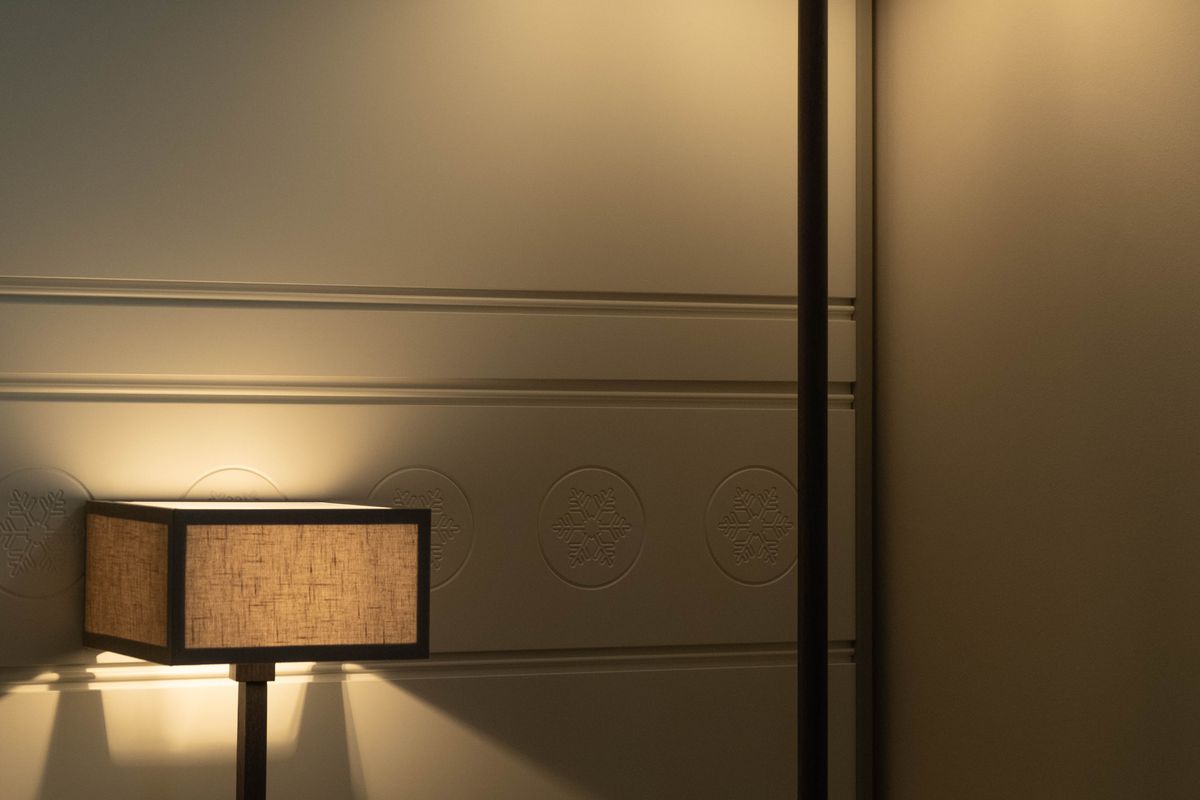
2700K for bedside and ambient light. Everything you see while lying in bed should glow at this temperature. It flatters skin, keeps fabrics looking soft, and gives the room its evening character. Every lamp you can touch from the bed should carry a 2700K bulb.
3000K for the dressing zone. If you have a wardrobe nook or a vanity, 3000K gives a fraction more clarity for matching colors while staying warm enough not to feel institutional. This is optional refinement, not a requirement - a whole bedroom at 2700K is never wrong.
Keep 3500K and above out of the room. Neutral and cool whites fight everything a bedroom is for. They also exaggerate contrast at night, which makes a warm room feel suddenly harsh when a cool bulb switches on. If your ceiling fixture came with cool bulbs, swapping them is the single fastest improvement you can make to the room.
Matching kelvin to your finishes
Warm light and warm materials reinforce each other. The Department of Energy notes that incandescent light around 2700K complements the wood finishes, furniture, and fabrics homes are furnished with - and in a bedroom this shows up most clearly in wooden bed frames, rattan, and linen, all of which deepen pleasantly under warm light. Cool light does the reverse: it grays out warm materials and makes even good furniture look tired.
If your room leans cool in its materials - painted white walls, metal, pale gray textiles - 2700K still works, because warm light against a cool palette reads as intentional contrast rather than clash. What does not work is cool light against a warm palette. When in doubt, warm wins every argument in a bedroom.
How to read a bulb box
The number you need is printed on the front of every standard package, in the light appearance section of the Lighting Facts label: brightness in lumens, and light appearance in kelvin. Look for the word “warm” or “soft white” plus 2700K, and ignore the watt-equivalence shorthand on the front - it tells you about brightness, not color.
Two other label details worth a glance. First, if the bulb goes into a dimmer, confirm the package says dimmable, because a non-dimmable LED on a dimmer flickers or dies early. Second, quality bulbs carry a color rendering score: ENERGY STAR certified bulbs must meet a CRI of 80 or higher, which is the difference between colors reading true under your lamps and everything looking faintly off. At the low prices LED bulbs sell for, there is no reason to buy a bulb with an unknown CRI. And if the bulb feeds a dimmer, remember that dimming is what lets a bedroom shift from working light to evening glow - the lighting layers guide shows how the layers use it.
Mixing temperatures without clashes
The honest rule: temperature clashes are a proximity problem, not a room problem. The Department of Energy warns that switching a whole room from 2700K to 4100K is immediately noticeable, and the same sensitivity applies at smaller scales - two adjacent lamps at different temperatures read as a mistake, while the same two at opposite ends of the room barely register.
So the practice is simple. Assign the sleeping zone one temperature, 2700K, and let every lamp in that zone share it, even across different fixture styles. If you use 3000K at a dressing corner, place the change where a wall or furniture break separates the two zones from each other. And never put a cool bulb in a fixture that sits in the same sightline as a warm one - the pairing will bother you every evening, even if you cannot articulate why.
A starting assignment for a whole room
If you want one prescription: buy 2700K bulbs for every lamp you reach from the bed, buy 3000K only if you have a dedicated dressing light, and walk the room at night once the bulbs are in, checking for any pair of mismatched lights sharing a view. For fine-tuning the evening end of the scale - dimming bulbs down to their warmest, lowest setting as part of a wind-down routine - the evening lighting routine builds the schedule, and the smart bulb guide covers the bulbs that automate it.
Frequently asked questions
- What kelvin is best for a bedroom?
- 2700K is the safest choice for a bedroom. It matches the warmth of old incandescent bulbs and flatters wood, textiles, and skin. Use 3000K only where you need a slightly more working light, such as a dressing area, and keep 4000K out of sleeping rooms entirely.
- Is 4000K bad for sleep?
- Cooler, bluer light at the high end of the kelvin scale reads as clinical and alert-making, which is why the Department of Energy pairs 4100K with offices and classrooms rather than homes. A bedroom used only for winding down does not benefit from it.
- Can you mix color temperatures in one room?
- You can, but only across distance. A 2700K bedside lamp and a 3000K dressing light in the same room rarely clash if they are never in view together. Two different temperatures side by side in one sightline is what looks wrong.