Color & Texture
Bedroom Rug Size and Placement, Solved
The two placement rules that decide bedroom rug size, the numbers for each bed size, and the clearances to check before you order anything.
By Mara Bennett · Published April 10, 2026 · Updated May 8, 2026
A bedroom rug is one of the few purchases that is mostly a measurement problem. The texture matters, the color matters, but if the size is wrong, none of it saves the room. I have watched people spend real money on a rug they loved in the showroom and then watch it die in the bedroom, parked under the bed like a loose floorboard, because nobody checked the numbers first. This is the checklist I run before any rug enters a bedroom, and it takes about ten minutes with a tape measure.
Why the rug size matters more than the rug
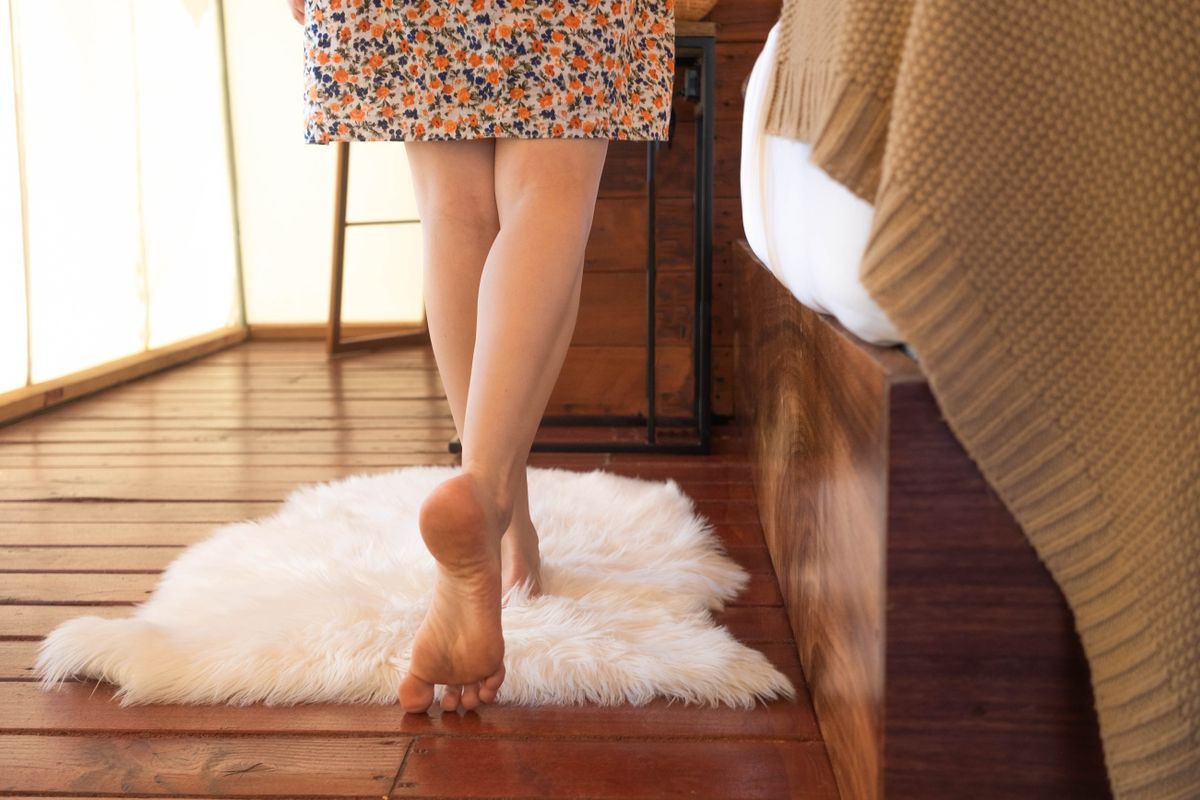
In a living room, a rug is furniture you can see. In a bedroom, most of it hides under the bed, so what you actually buy is the border - the visible frame of fabric that surrounds the bed and catches your feet in the morning. That frame is doing three jobs at once: it anchors the bed to the room, it softens every surface you step on when getting in and out, and it quietly quiets the floor.
When the border is too narrow, the rug stops reading as a frame and starts reading as a remnant. When it is too wide, it walks into the door swing, swallows the nightstand legs, or climbs the wall. Either failure costs the same: you end up with a large object in the room that contributes nothing. That is why I treat the rug like a piece of furniture with a footprint, not a finishing accessory - it gets measured, placed, and cleared for traffic just like the dresser.
The two rules: three sides down, or two-thirds tuck
Nearly every good bedroom rug I have placed follows one of two arrangements, and choosing between them is the first decision - before any size is bought.
Rule one: three sides landing. The rug starts under the bottom third of the bed and extends past both sides and the foot. You get soft landings on both sides of the mattress and at the foot when you get up in the night. It is the calmest, most complete look, and it costs the most floor area. The nightstands either sit fully off the rug or fully on it - half-on looks like a mistake and wobbles the lamps.
Rule two: two-thirds tuck. The rug starts under the lower two-thirds of the bed and extends past the sides and the foot, but the nightstands and the head of the bed stay on bare floor. This is the standard move for smaller rooms: it keeps the top of the room visually open, protects the walkway near the head of the bed, and still puts fabric exactly where feet land.
The numbers, by bed size
Once the arrangement is chosen, the size follows from the mattress. I work from these pairs, which leave a usable 45-60 cm (18-24 in) border on the working sides:
| Bed | Mattress width | Rug for three sides landing | Rug for two-thirds tuck |
|---|---|---|---|
| Single / twin, 99x191 cm (39x75 in) | 99 cm (39 in) | 160x230 cm (5’3”x7’7”) | 120x180 cm (3’11”x5’11”) |
| Full / double, 137x191 cm (54x75 in) | 137 cm (54 in) | 200x300 cm (6’7”x9’10”) | 160x230 cm (5’3”x7’7”) |
| Queen, 152x203 cm (60x80 in) | 152 cm (60 in) | 200x300 cm (6’7”x9’10”) or 240x300 cm | 160x230 cm (5’3”x7’7”) |
| King, 193x203 cm (76x80 in) | 193 cm (76 in) | 240x300 cm (7’10”x10’) or 250x350 cm | 200x300 cm (6’7”x9’10”) |
Check the queen row against your room before trusting it: a 200x300 cm rug with a queen centered on it leaves roughly 24 cm (9 in) on each side - fine for the two-thirds tuck, tight for a full three-sides frame. The 240x300 cm size is the honest three-sided answer for a queen, and it needs a wall run of about 330 cm (130 in) to breathe. If the room cannot give that, drop to the tuck arrangement rather than shrinking the border below 30 cm (12 in).
The bedside runner, and when it is the better answer
Rooms under about 2.7 m (9 ft) wide usually cannot afford a full rug. Two single beds, dormer rooms, and studio sleeping corners all belong here. In those cases I stop pretending and use runners: one 70x200 cm (2’3”x6’7”) strip on each open side of the bed, or a single wider strip on the one usable side of a wall-hug bed.
Runners solve the foot-landing problem honestly instead of badly. They also cost a fraction of a large rug, which leaves budget for pile quality where it counts. The trade-off is visual: two parallel strips can look like a gym if the room has no other softness, so I pair them with a heavier curtain or a textured throw to rebalance. If the bed sits against the wall, one runner on the open side plus a small 120x180 cm (3’11”x5’11”) rug at the foot often beats any full-size attempt.
Placement: the clearances a rug has to respect
A rug cannot be sized in isolation. Before ordering, I walk the room and check four things with the tape:
- Door swing. The rug must clear the door’s arc completely, or sit flat enough that the door passes over it. A thick pile under a door is a daily annoyance.
- Walkways. Where the route from the door to the bed crosses the rug, the rug should not narrow it below the 60 cm (24 in) you want for a comfortable path.
- Drawers. Any dresser or nightstand drawer that pulls out must clear the rug edge, or the rug must sit low enough that the drawer passes over it.
- The bed’s own clearances. The rug border should not be the reason a 45 cm (18 in) side clearance shrinks to nothing. Measure from the mattress, not from the rug edge.
For the full set of numbers I use around the bed, the guide to walkways and clearance planning covers every gap in the room, not just the ones under the rug.
Pile, texture, and what the rug does to the palette
Size is half the decision; pile is the other half. In bedrooms I favor low-pile and flatweave for anything that sits under a door swing or under drawer paths, and reserve deep pile for rooms where the rug has open clearance around it. High pile is the better barefoot experience, and next to a bed that matters more than in any other room - but it also holds dust and needs a stronger vacuum.
Texture is also how the rug links to the rest of the room. A flatweave in a natural fiber keeps a wood floor visible and suits a quiet, Scandinavian-leaning palette; a mid-pile wool rug in a muted tone adds the soft layer that a room of crisp cotton bedding usually lacks. I think about the rug as the floor’s answer to the bedding - it should carry some of the same weight and warmth, which is why I often match its tone to the layered bedding textures rather than to the wall paint.
The mistakes that cost the most
Three failures account for most rug regrets I see. First, buying for the bed alone: the rug fits the bed’s footprint but covers the heater vent, blocks a door, or leaves no path to the closet. Measure the room’s traffic first. Second, buying too small because it was cheaper - a 120x180 cm rug under a king bed is not a rug, it is a placemat; wait and buy the right size once. Third, ignoring thickness: a 4 cm (1.6 in) pile rug plus an underlay can raise the bed edge enough that the frame rocks or the door scuffs.
If you would rather skip the measuring and go straight to specific rugs, I sorted my current picks by bed size in the review of the best bedroom rugs by size, and each pick there maps to the size rows in this article.
Frequently asked questions
- What size rug goes under a queen bed?
- A 200x300 cm (6'7"x9'10") rug is the standard choice for a 152 cm (60 in) queen, giving about 24 cm (9 in) of rug on each side and a full landing zone at the foot. A 160x230 cm (5'3"x7'7") rug works if you place it under the lower two-thirds of the bed only.
- Should a bedroom rug go under the bed or beside it?
- Under the bed, if the room allows it - it anchors the bed and gives a soft landing on all working sides. Beside-the-bed runners are the fallback for rooms under about 2.7 m (9 ft) wide, where a full rug would eat the walkway.
- How far should a rug extend beyond the bed?
- Aim for 45-60 cm (18-24 in) on each usable side and beyond the foot of the bed. Less than 30 cm (12 in) reads as an accidental strip; the rug stops doing its job of framing the bed.